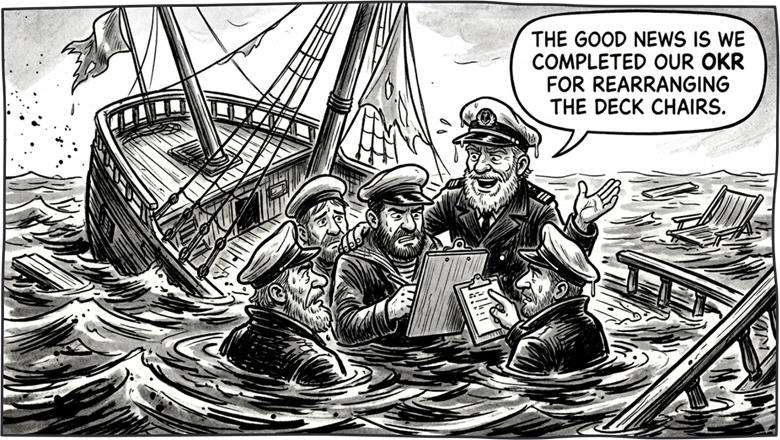
Is Your OKR Process Driving Strategy or Just Bureaucracy?
How to turn OKRs from bureaucratic theatre into a strategic engine for performance and growth
Thought Leadership
4
Minute Read
Minute Read
Minute Listening
Minute Reading
Minute Viewing
Series One
Episode
Article
22
Neel Doshi
Co-Founder and Director
Neel is the cofounder of Vega Factor and co-author of the NYT bestseller Primed to Perform, published in fall 2015 by HarperBusiness. Previously, Neel was a Partner at McKinsey & Company, founding member of an award-winning tech startup, and employee of several mega-institutions. He studied engineering at MIT, and received his MBA from Wharton.
Most organisations adopt OKRs with the right intention. The goal is to create clarity, align teams around strategy, and focus effort on the most important problems.
But somewhere along the way, the process often becomes heavier than the outcomes it was designed to enable.
Leaders find themselves spending hours negotiating wording, cascading targets through layers of the organisation, and reviewing progress against metrics that feel more like reporting than real strategic insight. The framework is still there, but the energy it was meant to unlock is missing.
From the inside, it can feel like the organisation is “doing OKRs.” Yet progress on the problems that actually move the business forward remains slow or fragmented.
This is where many organisations get stuck. Not because OKRs are flawed, but because they are implemented as a process to manage work rather than a system to solve strategic problems.
This article explores why OKRs often drift into bureaucratic theatre, what separates effective OKR systems from ineffective ones, and how leaders can redesign the process so it becomes a genuine engine for strategy, alignment and performance.
The 15-hour meeting trap: where strategy goes to die
Strategy doesn't die in the market. It dies in the 15th hour of an OKR review meeting.
A recent case study of a multinational firm revealed a leadership team spending 15 hours every week—two full workdays—reviewing their OKRs. Despite this massive administrative effort, they missed 30% of their strategic targets.
Many organisations have done to OKRs what happens to most great managerial movements: turned them into administrative compliance traps.
The global cost of this "strategic drift" is a staggering $1.4 trillion annually.
Most organisations are leaking value because they treat OKRs as an "autopsy", reviewing what went wrong during the annual review. In a volatile, AI-native world, this delay is fatal. To win, leaders must pivot from annual autopsies to a rhythm of high-frequency coaching that drives momentum in the flow of work.
The OKR diagnostic: Are you managing strategy or creating a pressure cooker?
Most executives have a nagging suspicion that their OKR process is more performance art than performance management. They see the effort, but they don't see the impact.
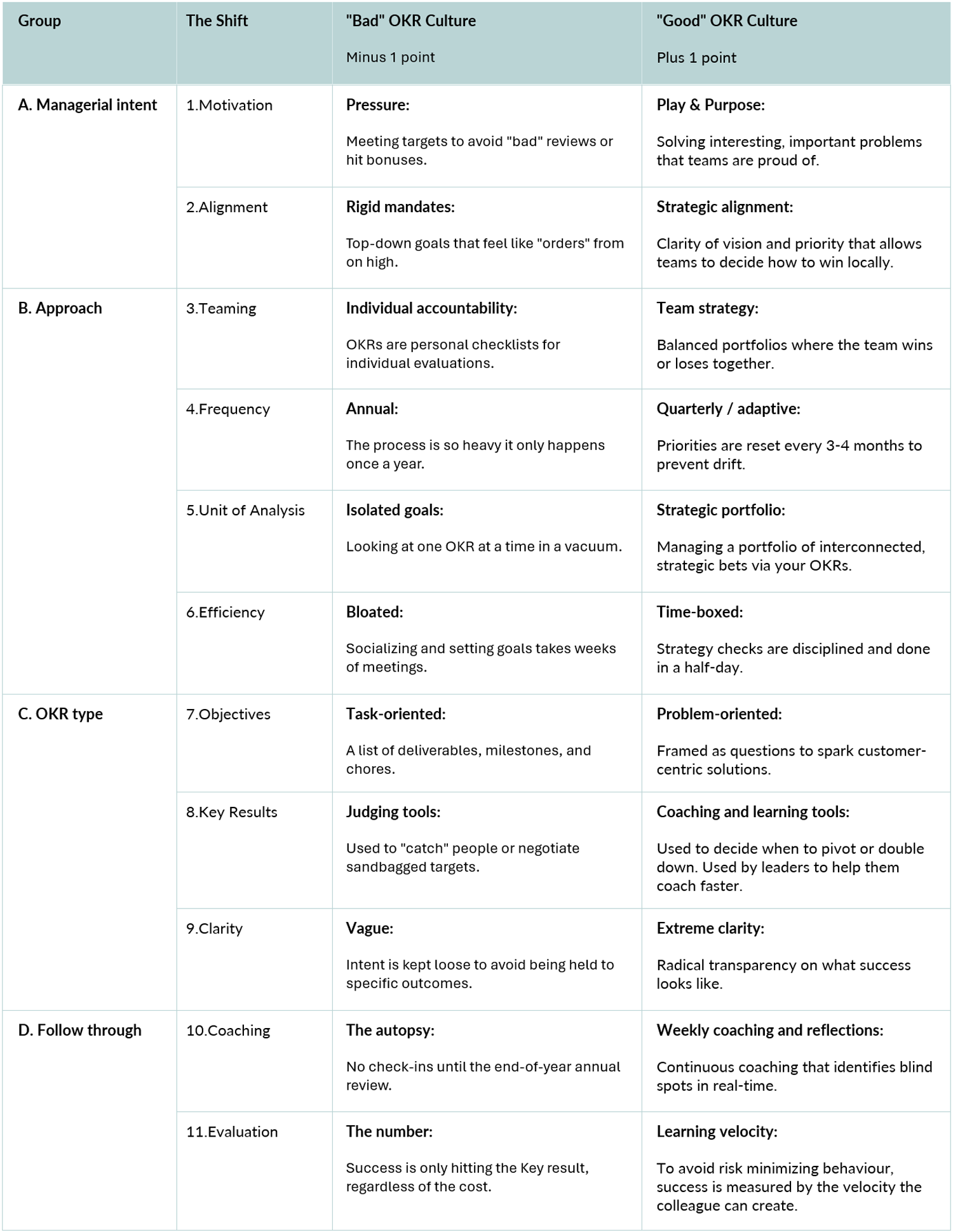
Use the 11-point litmus test below to determine if your performance culture uses OKRs well or toxically.
Score your organisation by choosing the column that most accurately describes your current reality. Be intellectually honest—the data is meant to identify where the system is stuck, not to find someone to blame.
If you don't understand any of the rows, you can find a more detailed explanation in Appendix 2.
What is your total score? (Range: -11 to +11)
-11 to -6 (Bureaucratic Toxic) Your process isn't just theatre; it's actively damaging your culture. High pressure and weaponized data are driving your best talent away while rewarding "sandbaggers."
-5 to 0 (The Administrative Tax) You are paying a high price in time and energy for very little strategic return. Your OKRs are likely a "check-the-box" exercise that teams ignore the moment the meeting ends.
+1 to +6 (The Messy Middle) You have the right intent, but your habits haven't caught up. You likely suffer from "strategic drift" because your check-in frequency is too low to catch problems in real-time.
+7 to +11 (High-performance organisation) You are building an high - performing organisations. Your teams treat goals as learning experiments and move with a radical velocity that competitors can't match.
Appendix 1 - What does a motivating, high-performing OKR actually look like?
An OKR should be an efficient tool to drive adaptive performance (growth, problem solving, and change). Therefore, an OKR must also be motivating. We'll keep this article up-to-date if we ever find better model, but for now, below is an example of the best model of OKR we've found.
OKR - OPERATIONAL TRANSFORMATION: 50% Process Optimisation
Objectives (i.e., the problems to solve)
This is a Strategic problem. Our Finance team is currently hindered by high levels of manual data analysis and routine reporting that consume over 50% of team capacity. This prevents us from acting as Strategic Architects or upskilling for the future vision of the department.
Deeper Root Causes:
Discovery Gap: We lack a centralized, quantified inventory of which specific BAU activities are the biggest "time-thieves" across our global offices.
Capacity Paradox: Teams are too busy with manual work to find the "protected time" required to learn the AI and automation tools needed to reduce that same manual work.
Structural Readiness: Our current systems and team skill sets aren't yet fully equipped to transition from manual execution to AI-powered oversight.
Key results
50% reduction in total hours spent on monthly reporting and routine data processing by the end of Q3.
Impact timing
When we expect to see enough impact to know if we should pivot or keep going: End of Q3
Problem solving guardrails:
Visioning - Our direction needs discovery: We need to figure out the right path for automation.
Exploring - Innovation-focused: We primarily need bold, high-leverage ideas that drive breakthroughs.
Galvanizing - Not yet fully equipped: We currently lack some of the systems or structures needed to succeed.
Achieving - Execute deliberately: Build consensus and alignment across functions before moving forward.
Milestones
Completion of the BAU "Process Inventory" and effort-impact mapping.
Presentation of Discovery findings and automation roadmap to Sarah for alignment.
Execution and review of the first "Bold Innovation" AI pilot for report automation.
Mid-point Culture Check to assess workload sustainability and protected learning time.
WorkFORCE
Owners: Alex Chen
Coaches: Sarah Jenkins, Marcus Thorne
Experts: Elena Rodriguez, Maria Garcia, David Okoro
Followers: James Wilson
Reviewers: Linda Zhang
Appendix 2 - deep dives on each dimension
True ownership doesn't come from top-down orders; it comes from an extreme clarity of intent that allows teams to decide how to win. Use these questions to test the health of your strategy.
Group A: Managerial intent
The most common CEO frustration we hear isn't the strategy itself—it’s the lack of ownership further down the line. They wonder why teams aren't taking more initiative. The answer usually lies in the intent behind the goal-setting process. If the intent is control, you get compliance. If the intent is alignment, you get ownership.
Q1: How can we make sure OKRs motivate colleagues as opposed to burning them out?
Most leaders inadvertently use OKRs to increase economic and emotional pressure by framing them as "gotcha" tools in reviews. This is a fast way to kill adaptive performance and innovation.
To drive high performance, you must pivot the intent toward Play and Purpose. People are most creative and resilient when they are solving an interesting, important problem because it matters to the customer, not because they are afraid of a missed target.
Q2: Why is strategic alignment more powerful than cascading mandates?
The old-school "cascading" mandate believes that the most important thing is for teams to see the strategic themes of the company. But this doesn't really help them take ground quickly.
Strategic alignment works differently. The CEO creates high-level OKRs. Then the teams below them use their strategy check process to either set OKRs that ladder up (global), or set OKRs that solve for their own performance needs (local).
By giving colleagues the option, they are now thinking, not just reacting.
Group B: Approach
If your goal-setting process takes weeks of socialisation and dozens of meetings, the bureaucracy is already winning. High-performance isn't about the amount of time you spend planning; it’s about the velocity of your execution.
Q3: How do we balance individual accountability with a team strategy?
In most "OKR Theatre," goals are personal checklists used for individual evaluation. This is a recipe for silos and finger-pointing.
High-performing organisations treat OKRs as a team strategy first. The team wins or loses as a unit. Within that team strategy, individuals own specific pieces of the portfolio, but the logic is clear: the collective outcome matters most. This prevents the "I hit my goal but the company failed" paradox.
Q4: Why must the OKR cycle happen every three to four months instead of annually?
Annual plans are too slow to be adaptive. In an AI-native world, the assumptions you make in January are often obsolete by April.
Frequent resets—every 90 to 120 days—act as a "Strategy Check" to ensure your priorities are still the right ones. This frequency prevents strategic drift, where a team spends months working on something that no longer creates value.
Q5: Why should we manage goals as a portfolio rather than individually?
Think of your team's OKR portfolio as a stock portfolio. If you buy stocks completely independently of each other, you run the risk of not having a balanced portfolio.
A portfolio is strategic: it’s a balanced set of bets. A healthy team portfolio includes a mix of near-term wins and long-term experiments, and high-risk versus low-risk initiatives. By managing the portfolio together, teams can proactively decide to double down on what’s working and cut losses on what isn't.
Q6: How can we actually build OKRs in 4 hours when it used to take us weeks?
Speed comes from discipline, not cutting corners. First, use a time-boxed Strategy Check—budget a half-day, not a half-month. Second, leverage AI tools like Factor.ai to synthesize data and draft options instantly, moving the team from "blank page" to "critique and decide."
When you stop treating OKRs as a permanent contract and start treating them as adjustable hypotheses, the pressure to spend weeks "socializing" them disappears.
Group C: OKR type
If your objective looks like a to-do list, it isn't an OKR; it's a chore. High-performance teams don't just "check boxes"—they solve problems.
Q7: Why must Objectives be framed as "problems to solve"?
Task-oriented goals are difficult to coach and put people in a check-the-box mindset. They start to think their job is to complete tasks, rather than have an impact. Framing goals as problems to solve transforms the work from a list of deliverables into a strategic challenge. It sparks "Play" and curiosity, giving your team the space to pivot when they realize a specific task won't actually move the needle.
But perhaps most importantly, it helps your leaders coach the success of the OKR. Leaders are often swamped. But to ensure that an OKR is actually successful, they have to make sure that the core problem is solved. Making sure that's clear in the OKR helps leaders context-switch faster.
Q8: What does a good Key Result look like?
A good Key Result is a diagnostic tool, not a judging tool. If your KRs are just milestones (e.g., "Finish the report"), you are measuring activity, not impact. Effective KRs capture the actual shift in the system. They should be impact-oriented and, if necessary, established specifically for that OKR—even if they aren't part of your permanent dashboard. Use the "So What?" Test: if your team hits the KR perfectly but the business hasn't actually improved, you've set a task, not a result.
Q9: Why is "extreme clarity of intent" the antidote to micromanagement?
Vagueness is an "unforced error" often born from a fear of accountability. But you cannot coach a cloud. To move with velocity, you need extreme clarity of intent across four specific dimensions:
workFORCE: Radical transparency on who is Owning, Coaching, or merely Following the work.
Guardrails: Clear expectations on whether the team should be "Exploring" (innovating) or "Achieving" (executing).
Impact Timing: A specific date when you believe you'll have enough data to know if the bet is working.
Milestones: The critical deliverables that act as breadcrumbs toward the larger objective.
Group D: Follow through
The "set-and-forget" model of performance management is a relic of a slower era. If you only check in on your OKRs at the end of a quarter, you aren't managing performance—you’re conducting an autopsy to find out why the strategy died.
Q10: Why is weekly coaching 3.6x more effective than a quarterly review?
Engagement and progress are products of frequency. Research shows that employees who receive feedback at least weekly are 3.6 times more likely to be engaged and 2.7 times more likely to feel they are making progress compared to those on quarterly cycles.
Weekly coaching sessions are not about "status updates." They are strategic interventions designed to identify blind spots and remove blockers in real-time. By moving to a rhythm of continuous performance dialogue, organizations see a 31% improvement in alignment because teams can pivot their tactics the moment a hypothesis is proven wrong.4
Q11: How do we move from judging "the number" to judging "velocity"?
If you only reward people for "hitting the number," you incentivise sandbagging and safe, uninspired goals. This is how you end up with "Cobra Effects"—where employees simulate activity or cut corners just to make the metrics look good.
In a high-performance culture, success is measured by learning velocity the rate at which a team conducts experiments, gathers data, and adapts. Judge your OKR owners on their momentum and their ability to pivot based on evidence. Simultaneously, judge your OKR coaches on how effectively they are removing friction. Velocity is the lead indicator that predicts long-term success.
Conclusion: Moving from score -11 to score +11
Scaling a high-performance culture requires more than just installing new software; it requires a fundamental shift in how your leaders lead. If your diagnostic score was low, the path forward isn't more bureaucracy it's apprenticeship.
The most successful "AI Native & People First" organizations prioritize on-the-job skill development. They eliminate the "praise sandwich" and replace it with a culture where seeking feedback is a sign of strength, not weakness. By treating your OKR process as a strategic engine rather than a bureaucratic tax, you ensure that as technology accelerates, your people are the ones driving the win.
If this article resonates with your challenge, let us help you sort it out!
If you could hear any of your challenges in this podcast, we can help!
Want to engage with our Solution Partners, schedule a call now!
Wanting to achieve similar success across your organisation?
Did this recording echo challenges you may be experiencing in your workplace, let us help!
As a community of like-minded clients and solution partners, we're driven to improve the workforce so every organisation and their employees can thrive.