How Excuse-Making Derails Transformational Change in Organisations
Why leaders tolerate excuses, fear the dip, and let pressure derail transformation
Thought Leadership
4
Minute Read
Minute Read
Minute Listening
Minute Reading
Minute Viewing
Series Two
Episode
Article
13
Neel Doshi
Co-Founder and Director
Neel is the cofounder of Vega Factor and co-author of the NYT bestseller Primed to Perform, published in fall 2015 by HarperBusiness. Previously, Neel was a Partner at McKinsey & Company, founding member of an award-winning tech startup, and employee of several mega-institutions. He studied engineering at MIT, and received his MBA from Wharton.
Most leaders don’t resist transformation because they don’t believe in it. They resist it because, in the middle of delivery pressure, change feels risky.
You set the strategy. You announce the transformation. The intent is clear. Then performance dips, timelines stretch, and the organisation starts to get uncomfortable. Questions turn into caveats. Caveats turn into explanations. And before long, what looks like “reasonable context” becomes a pattern of excuse making that quietly slows everything down.
From the inside, it rarely feels like failure. It feels like pragmatism. Protecting performance. Being realistic. Keeping people safe. But over time, these well intentioned moves hard wire fear of the dip into your systems, incentives and leadership behaviours. The organisation learns to defend today instead of building tomorrow.
This is where many transformations stall. Not because the strategy was wrong, but because the organisation couldn’t tolerate getting worse before it got better.
This article explores why that happens, how excuse making becomes embedded in otherwise capable organisations, and what leaders must do differently to drive real, sustained transformation.
How excuse-making derails transformational change and leads to the death of companies
It isn't just you. Leading in the last five years has been an absurdly wild ride.
Covid. Remote work. Gen Z work preferences. Supply chain bullwhip effect. Political volatility. Trade wars. The rise of TikTok. The power and hype of AI. And all of this in only the last five years.
Just the last five years!!!
Now ask yourself, how many of these changes did your company predict in its strategy five years ago? None.
Welcome to the era of permanent change.
In this era, adaptability is the most important capability. So why, then, do so many organisations struggle with change?
Research consistently shows that only 3 out of 10 corporate transformations succeed. Why?
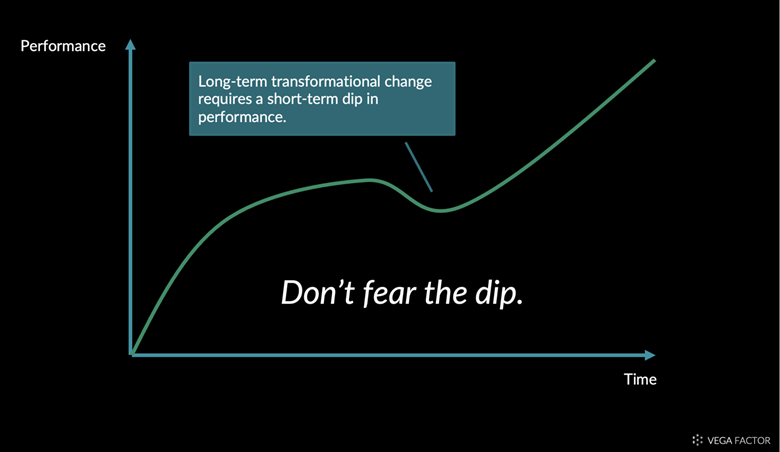
There's one major insight that explains why so many leaders struggle to drive transformational change in their organisations. They don't realise that transformational change means performance will get worse before it gets better. And their organisations don't tolerate the dip.
What is transformational change, and why is it so hard to get right?
Greatness is never set it and forget it.
Consider a contender for GOAT of GOATs: Roger Federer. By 2016, at an age when most players are retiring, he chose a different path.
The physicality of the modern game, dominated by younger, more athletic players, proved to be too much for his aging body. Instead of going gentle into that good night, he changed his game.
For the year, he fundamentally overhauled his gameplay a style that others would have considered perfect.
To conserve energy and shorten points, he reinvented his backhand, stepping further into the court and taking the ball earlier to hit flatter, more powerful shots. He also increased his net approaches to finish points more quickly. This was a deliberate shift: less grinding from the baseline, more attacking, more risk, and more pressure on his opponents to end rallies fast.
This kind of change couldn't be done without a temporary dip, and while he was making it, his performance suffered. His rank slid to 16 in the world, and many considered his best days over.
Federer understood that there are two types of change.
First, there's incremental change; these are changes where performance improves immediately. For example, simple process changes in companies can improve performance right away.
Second, there's transformational change.
A typical large language model's definition for transformational change is: "a profound, radical shift that fundamentally alters the core of an organisation, often in response to or anticipation of major changes in its environment or technology."
But for leaders, the most critical thing to understand is this: transformational change is when performance will worsen before it gets better again. And that's exactly why these changes are so difficult to lead.
Why do companies fear the dip and thus fail at change?
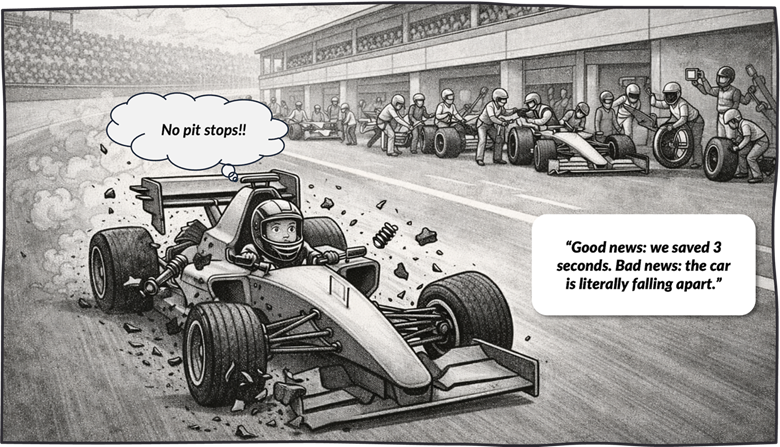
Transformational change requires companies to endure a dip in performance as they learn to change their game. But many companies fear the dip.
That fear isn't simple to fix. It's built into the bones of the organisation. To lead through this challenging aspect of change, it's important for leaders to understand how fear gets codified into their very systems and structures:
Mistaking niceness or cruelty for motivation
Using pressure to drive BAU (and thus preventing growth)
Seeking buy in rather than seeking action
Using BAU feedback loops to drive transformational change
Can we be nice and high performing?
Too many companies have so over indexed to "psychological safety" that they've made their companies less motivating.
Before the sour comments pour in, are there still toxic leaders? Yes. Should they be toxic? No.
But under the flawed flag of psychological safety, too many companies have replaced motivation for sterile, nice, conflict avoidant companies.
To understand how to thread the needle between a safe culture and a challenging culture, leaders must understand the first principles of how motivationworks.
I'm going to compress our book, Primed to Perform, into two paragraphs, but if you lead humans at work, read the whole book.
There are fundamentally six motives (reasons why we do things). These motives are the roots of motivation:
First, the motives that come from challenge:
Play: you do something because it is fun. But it is fun because it is challenging or novel in some way.
Purpose: you do something because your contribution matters.
Potential: you do something because it will lead to something meaningful to you.
The best performance coaches, like the ones who build the best high-performing teams, use these motives as their primary form of motivation.
The application of these motives doesn't always feel "nice." Challenge sometimes comes from tough love, conflict, or hand holding.
On the other hand, there are three motives that come from coercion or apathy:
Emotional pressure: like fear of judgment
Economic pressure: like the pursuit of rewards or avoidance of punishment
Interia: no reason for action
These three motives may instigate an action, but do not result in sustained, adaptive performance.
When leaders are "nice" and thus conflict averse, they are unlikely to be motivating. Often this feels like inertia, even the leader doesn't seem motivated to perform. These leaders will not successfully navigate their organisations through the dip.
How can we create growth mindset in our organisation?
In at scale organisations, there are two types of work:
BAU (business as usual): BAU work is about keeping the lights on, defending your share, and maintaining momentum. It's all about keeping the company on its current course.
Growth: Growth is new efforts. Zero to one initiatives. Growth is about creating a new course.
Transformational change falls into the Growth category, but most organisations have management systems fixated on BAU.
All the metrics: BAU.
Compensation: BAU.
Management routines: BAU.
Goals: BAU.
BAU work has all the motivation and pressure, so BAU work doesn't just fill your calendar; it dominates it.
The most common rhetorical tactic used by leaders in these systems is the false choice. It sounds a bit like this: "Well, I can either close the deal with that client or participate in this transformation."
Instead, executives have to be prepared to say, "I understand this won't be easy, but we must figure out a way to do both, and figure it out together. We're in the era of permanent change. Winning today and losing tomorrow isn't any better than losing today and winning tomorrow."
How can I create buy in for difficult change?
In the late 90s, I pitched a transformational strategy for the internet to the then CEO of Citi, John Reed. I was 21 at the time (and deeply clueless), so he said I needed an executive sponsor for this idea. He introduced me to a number of executives, to see if I could get buy in.
One executive flat out told me, "I agree with your idea completely, but I'm not going to support it. I'm two years from retirement, and I'm not going to stick my neck out for anything new."
The problem with seeking "buy in" for transformational change is that there are too many reasons to not buy-in that have nothing to do with the quality of the idea:
As you saw above, an executive may not have the same time horizon as the transformation.
An executive may be unwilling to self sacrifice. Sometimes a transformational change requires one organisation to sacrifice its own productivity or headcount for the betterment of the whole.
A colleague may be afraid of seeming incompetent during the dip.
An executive may not understand the change, but won't fully understand it until they start doing it (like riding a bicycle).
The worst case is that rather than openly discussing these reasons, the buy-in process is co-opted for stall tactics. Requests for more information. More trainings. More meetings. More analysis. Strings of perpetual short delays.
Rather than spending all this time aiming for buy-in, instead focus on making the steps of the transformation bite sized. Momentum makes momentum, so aim to get past the cold start problem as fast as possible.
How can we measure progress during transformational change?
Imagine you're Roger Federer during his own transformational change. How would you measure results? It couldn't be points or even matches won, because he's getting worse before he gets better.
The challenge of transformational change in companies is that their BAU measurement systems won't work.
Instead, organisations have to do something that is often alien to them. They have to:
Understand the theory of the case.
Evaluate actual behaviors versus the specific behaviors required in the theory of case.
Segment their employees into Innovators, Early adopters, Early majority, Late majority, and Laggards, focusing first on the innovators.
Take the time to learn how to master the needed behaviors.
If an organisation is primarily accustomed to BAU management systems, this will feel uncomfortable to them.
Pulling it all together
We've been focused on a critical implication of transformational changes that performance gets worse before you get better. There's a reason for that.
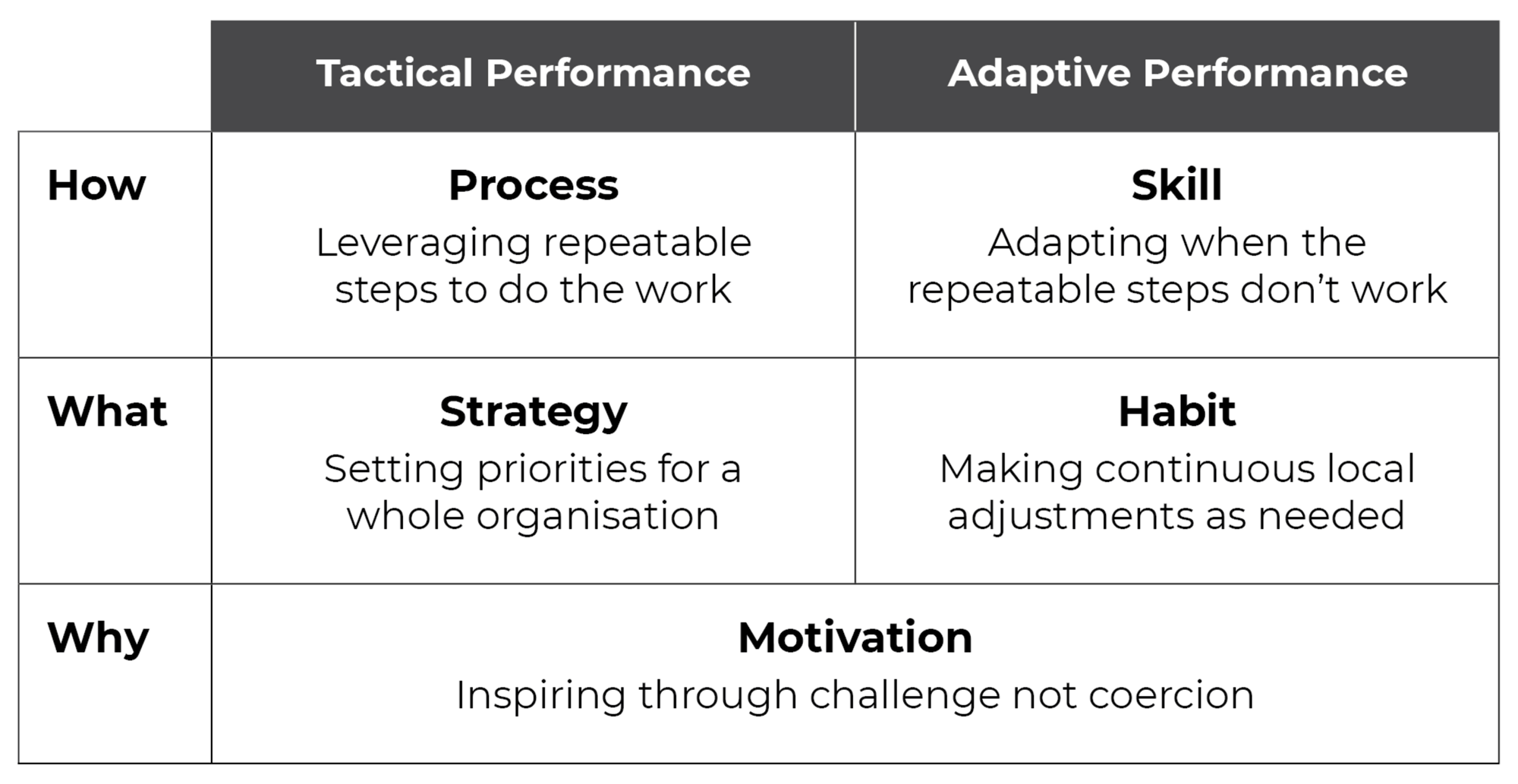
Transformational changes typically require adaptability. The people in the change either have to learn new skills (which takes time) or make local adjustments to the recommendation (which also takes time to figure out).
Think about it this way. When driving performance, leaders have to drive tactical and adaptive performance and for each, the why, what, and how.
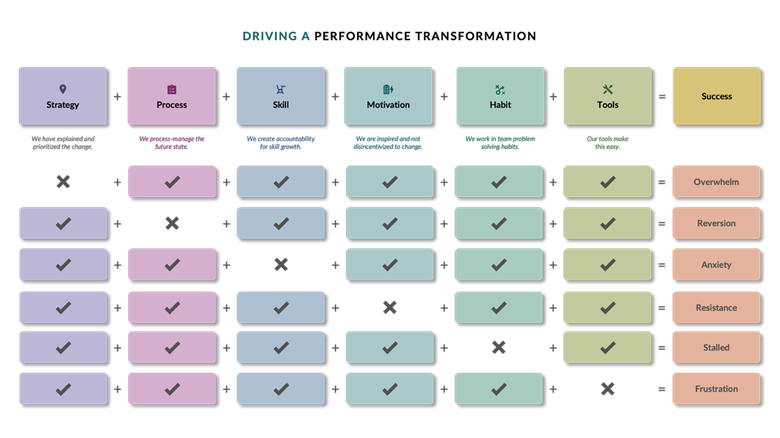
To drive transformational change effectively, you need to make all five of these levers, plus your facilitating tools, work toward the change. Missing any one of them results in common barriers to change.
If you're stuck in a transformation change that is going slower than you want or is trending in the wrong direction, reach out to info@sprouta.com. We're happy to spend 20 minutes on a call to see if we can help you get unstuck.
If this article resonates with your challenge, let us help you sort it out!
If you could hear any of your challenges in this podcast, we can help!
Want to engage with our Solution Partners, schedule a call now!
Wanting to achieve similar success across your organisation?
Did this recording echo challenges you may be experiencing in your workplace, let us help!
As a community of like-minded clients and solution partners, we're driven to improve the workforce so every organisation and their employees can thrive.